
Category: Science
Subcategory: Quantum Theory
Series: Quantum Theory — From Probability to Reality
Reading Time: 6–7 minutes
Introduction
In our journey through Quantum Theory, we began with a simple but revolutionary idea: at the quantum level, nature does not always behave according to the rules we experience in everyday life.
Classical physics gives us a familiar picture of reality. A ball is a ball. A wave is a wave. An object has a position, a speed and a definite path. If we know enough about the object and the forces acting on it, we can calculate where it will be in the future.
The quantum world challenges this intuition.
One of the most remarkable discoveries in modern physics is that entities such as light and electrons can display both wave-like and particle-like behaviour.
This phenomenon is known as wave–particle duality.
It is not simply a strange feature of quantum theory. It represents a fundamental change in the way we understand physical reality.
Light: A Wave or a Particle?
The story begins with light.
For a long time, scientists debated whether light was made of particles or behaved as a wave.
The wave description became extremely successful. Experiments involving interference and diffraction showed that light could produce patterns that are characteristic of waves.
Imagine dropping two stones into a calm pond. Each stone creates expanding waves. Where the waves meet, they can reinforce one another in some places and cancel one another in others.
Light can produce a similar phenomenon.
When light passes through two narrow openings, an interference pattern can appear on a screen behind them.
This is strong evidence of wave-like behaviour.
But another set of experiments revealed something equally surprising.
Light also behaves as if it comes in discrete packets of energy.
These packets are called photons.
The energy of a photon depends on the frequency of the light. This became particularly important in understanding the photoelectric effect, where light can cause electrons to be emitted from certain materials.
Albert Einstein's explanation of the photoelectric effect helped establish the idea that electromagnetic radiation has a particle-like aspect.
So what exactly is light?
A wave?
A particle?
Quantum theory tells us that the classical question itself is incomplete.
The Electron Creates an Even Bigger Mystery
The real surprise came when scientists discovered that matter itself could behave like a wave.
Electrons had already been understood as particles with mass and electric charge.
But experiments showed that electrons can also produce diffraction and interference patterns.
This means that something we normally imagine as a tiny particle can exhibit behaviour associated with waves.
Louis de Broglie proposed a remarkable idea in 1924: if light, traditionally considered a wave, can behave like particles, perhaps particles can also possess wave-like properties.
He proposed that a moving particle has an associated wavelength.
This became one of the foundations of modern quantum mechanics.
The idea was later confirmed experimentally.
The Double-Slit Experiment
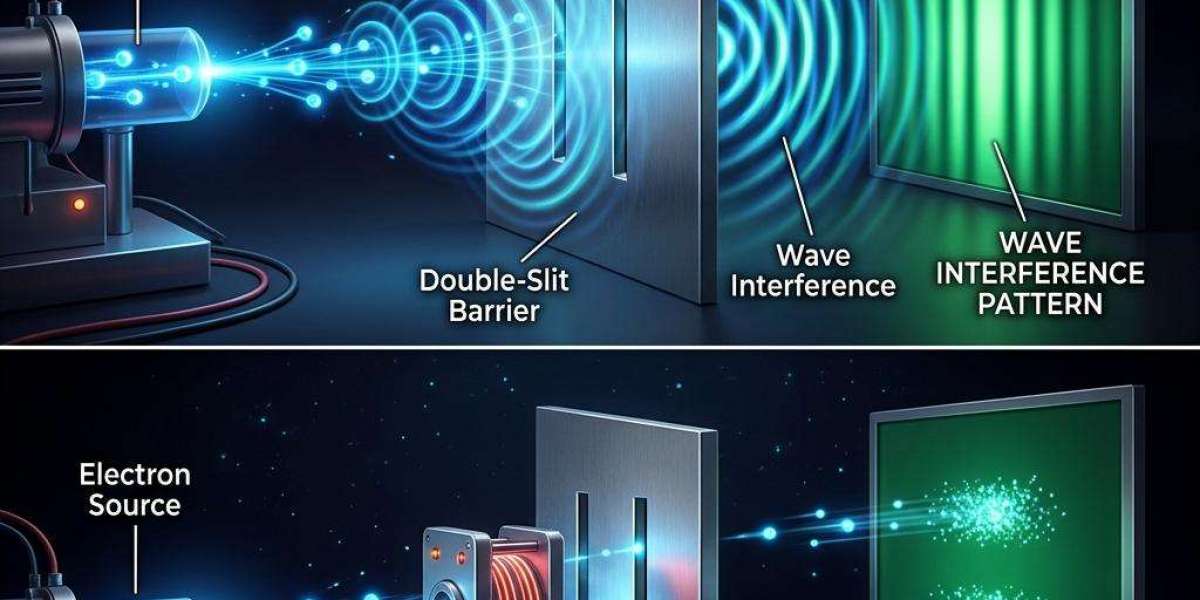
Perhaps the most famous demonstration of quantum behaviour is the double-slit experiment.
Imagine firing electrons toward a barrier containing two narrow slits.
If electrons were simply tiny classical particles, we might expect two bright bands on the screen behind the barrier—one corresponding to each slit.
But when electrons pass through the experiment under suitable conditions, an interference pattern can emerge.
That is a wave-like result.
The mystery becomes deeper when electrons are sent one at a time.
Each electron is detected at a single point on the screen.
That looks like particle behaviour.
But after many electrons have been detected, the collection of individual points gradually forms an interference pattern.
It is as if each individual quantum event is localized like a particle, while the overall probability distribution behaves like a wave.
This is one reason quantum mechanics is so different from classical physics.
Does the Electron Split into Two?
A natural question arises.
If an electron produces an interference pattern, does that mean the electron physically splits into two pieces and travels through both slits?
Quantum theory does not describe the situation in that simple classical way.
Instead, the quantum state is described mathematically by a wavefunction.
The wavefunction contains information about the possible outcomes of measurements.
When both paths remain possible and coherent, their quantum amplitudes can interfere.
If an experiment is arranged so that information about which slit the electron passed through becomes available, the interference pattern can disappear or change.
This leads to one of the deepest lessons of quantum mechanics:
The result of an experiment depends not only on the object being studied, but also on how the measurement is arranged.
Observation Is Not Simply “Looking”
This point is often misunderstood.
Quantum mechanics does not necessarily say that human consciousness magically changes reality merely because someone looks at an experiment.
In physics, a measurement involves a physical interaction.
A detector, for example, can interact with a quantum system and leave information about its state in the surrounding environment.
Such interactions can destroy the conditions required for quantum interference.
This connects wave–particle duality to another major concept we will explore later:
quantum measurement and decoherence.
A New Picture of Reality
Wave–particle duality forces us to reconsider a basic assumption.
Perhaps quantum objects should not be thought of as tiny classical balls or ordinary waves.
They belong to a deeper physical description in which concepts such as state, probability, amplitude, measurement and interaction become fundamental.
The classical categories of “particle” and “wave” are useful descriptions of different experimental behaviours, but neither provides the complete quantum picture by itself.
Quantum theory does not ask nature to choose between the two.
Instead, it gives us a mathematical framework capable of describing phenomena that appear particle-like in one experimental context and wave-like in another.
From Waves to Possibilities
This brings us back to the central theme of our Quantum Theory journey.
At the quantum level, nature is not always described by a single predetermined story.
Instead, quantum theory gives us a structure of possible outcomes and their probabilities.
The wavefunction evolves according to precise mathematical rules. Measurements produce definite observable results.
Between these two aspects lies one of the deepest questions in physics:
What does the quantum wavefunction actually represent?
Is it a physical wave?
Is it information?
Is it a mathematical description of possibilities?
Different interpretations of quantum mechanics give different answers.
And this is where physics begins to meet philosophy.
The Journey Continues
Wave–particle duality is only the beginning.
Once we accept that quantum objects cannot always be understood using ordinary classical concepts, several even stranger ideas emerge.
Why does a quantum system exist in a superposition of possibilities?
What exactly happens during a measurement?
Can two particles become connected through quantum entanglement, even when separated by enormous distances?
And could these strange properties eventually transform computing, communication and technology?
These questions take us deeper into the structure of quantum reality.
In our next article, we will enter one of the most important ideas in quantum mechanics:
Superposition: How Can Something Exist in More Than One Possibility?
The journey from probability to reality has only just begun.