
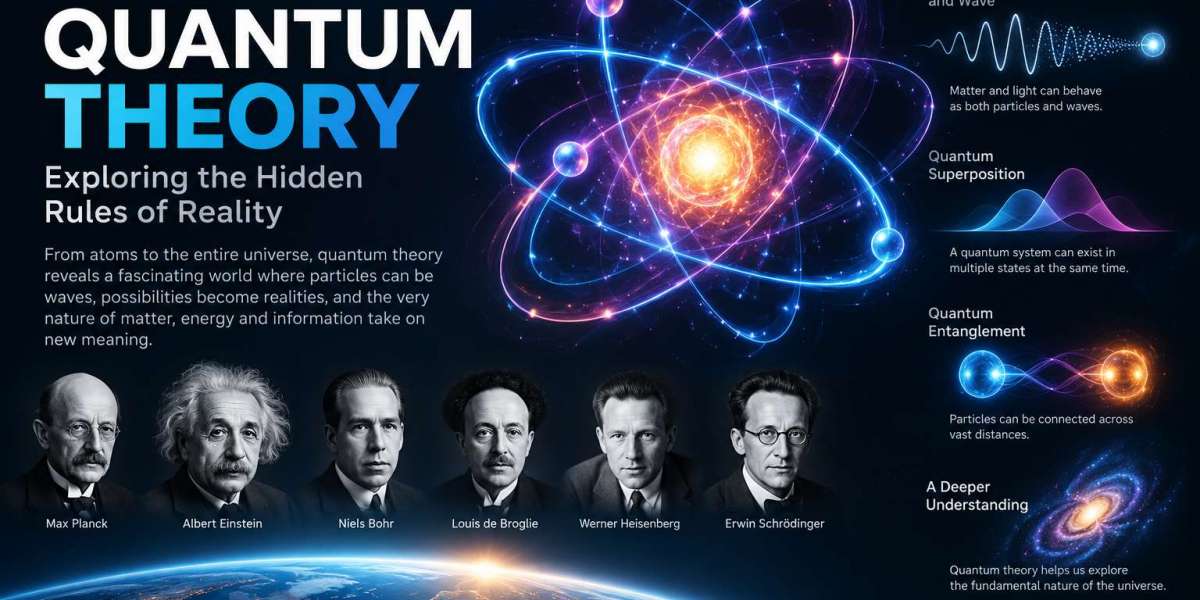
For centuries, human beings tried to understand nature by observing what they could see. A stone falls, a planet moves, water flows, light travels, and objects appear to have definite positions and speeds. Classical physics, developed through the work of scientists such as Galileo and Newton, gave us an extraordinarily successful framework for describing this visible world.
But as scientists looked deeper—into atoms, light, and the smallest components of matter—they discovered something unexpected.
The rules that seemed obvious in the everyday world began to break down.
An electron could not always be described simply as a tiny ball moving around an atomic nucleus. Light, which had long been understood as a wave, could also behave as if it were made of individual packets of energy. Particles could display wave-like behavior. The act of measurement itself could become important. And nature appeared to operate according to probabilities rather than always providing a single predictable outcome.
This strange territory became the quantum world.
Quantum theory is the framework developed by physicists to describe nature at very small scales—particularly atoms, electrons, photons, and other fundamental particles. The word quantum comes from the idea of a discrete amount or “quantity.” At the microscopic level, certain physical properties do not always change continuously. Energy, for example, can be exchanged in specific amounts under particular circumstances.
The beginnings of quantum theory can be traced to a problem with something as ordinary as hot objects.
When an object is heated, it emits electromagnetic radiation. Physicists in the late nineteenth century attempted to calculate how much energy would be emitted at different frequencies. Classical physics produced a disastrous prediction: at very high frequencies, the calculated energy would become effectively infinite. This contradiction became known as the ultraviolet catastrophe.
In 1900, Max Planck proposed a radical solution. He suggested that energy exchange did not occur in an entirely continuous manner. Instead, energy could be emitted or absorbed in discrete packets. This was one of the first steps toward quantum physics.
A few years later, Albert Einstein took the idea further. In explaining the photoelectric effect, he proposed that light itself could behave as if it consisted of individual packets of energy, later called photons. Light was no longer simply a continuous wave.
Then came another remarkable discovery.
Atoms had always been imagined as tiny systems, but experiments showed that electrons could occupy particular energy states. They could move between these states by absorbing or releasing specific amounts of energy. Niels Bohr developed an early quantum model of the atom, helping scientists understand why atoms emit particular frequencies of light rather than every possible frequency.
But the deeper scientists went, the stranger the picture became.
Louis de Broglie proposed that matter could have wave-like properties. Experiments later confirmed that electrons can produce interference and diffraction patterns—phenomena traditionally associated with waves.
So what exactly is an electron?
Is it a particle?
Is it a wave?
The answer is not as simple as either choice.
Quantum mechanics does not describe microscopic objects using exactly the same concepts we use for everyday objects. Instead, it provides a mathematical description of the possible states of a system and the probabilities of different measurement outcomes.
This is where one of the central ideas of quantum theory appears: probability is not merely a consequence of our lack of knowledge. It is built into the theory itself.
Before a measurement, quantum mechanics may describe several possible outcomes. The theory allows us to calculate the probability of obtaining each one. When an experiment is performed, however, we observe a particular result.
This does not mean that quantum physics is vague or unscientific. Quite the opposite. Quantum mechanics is one of the most accurately tested theories in the history of science. Its predictions have been confirmed through countless experiments, and modern technology depends on quantum principles.
Lasers, transistors, semiconductor electronics, magnetic resonance technologies, LEDs, solar cells and many other technologies have roots in quantum physics.
Yet quantum theory raises questions that go far beyond technology.
What does it actually mean for a particle to have a quantum state?
What happens when we measure it?
Can two particles become connected in a way that cannot be explained by ordinary classical relationships?
Why does nature allow multiple possibilities before measurement?
What is the role of the observer?
And perhaps the deepest question of all:
Is the quantum world fundamentally different from the world we experience, or is our everyday reality itself emerging from quantum rules?
To explore these questions, physicists developed increasingly powerful mathematical and experimental tools. The quantum state can be represented mathematically by a wave function, which contains information about the possible outcomes of measurements. The Schrödinger equation describes how this quantum state changes with time. Other formulations, developed by scientists such as Werner Heisenberg, Paul Dirac and others, provided different but deeply connected ways of understanding the same underlying physics.
Quantum theory also introduced the uncertainty principle, showing that certain pairs of physical quantities—such as position and momentum—cannot simultaneously be known with arbitrary precision. This is not simply a limitation of imperfect instruments. It reflects a fundamental feature of quantum systems.
And then there is quantum entanglement.
Two quantum systems can become correlated in such a profound way that measuring one is connected to the possible outcomes of measurements on the other, even when they are separated by large distances. Experiments have repeatedly confirmed quantum predictions concerning entanglement, making it one of the most fascinating features of modern physics.
Our journey through quantum theory will begin with these foundations.
We will start from the earliest questions about light and matter, follow the experiments that challenged classical physics, and gradually build our understanding of atoms, photons, wave functions, uncertainty, superposition and entanglement.
We will not begin with complicated mathematics.
Instead, we will begin with a simple question:
Why did physicists need a completely new theory in the first place?
The answer lies in a series of experiments that revealed that nature, at its deepest level, does not behave quite the way our everyday experience suggests.
This is where our journey into the quantum world begins.