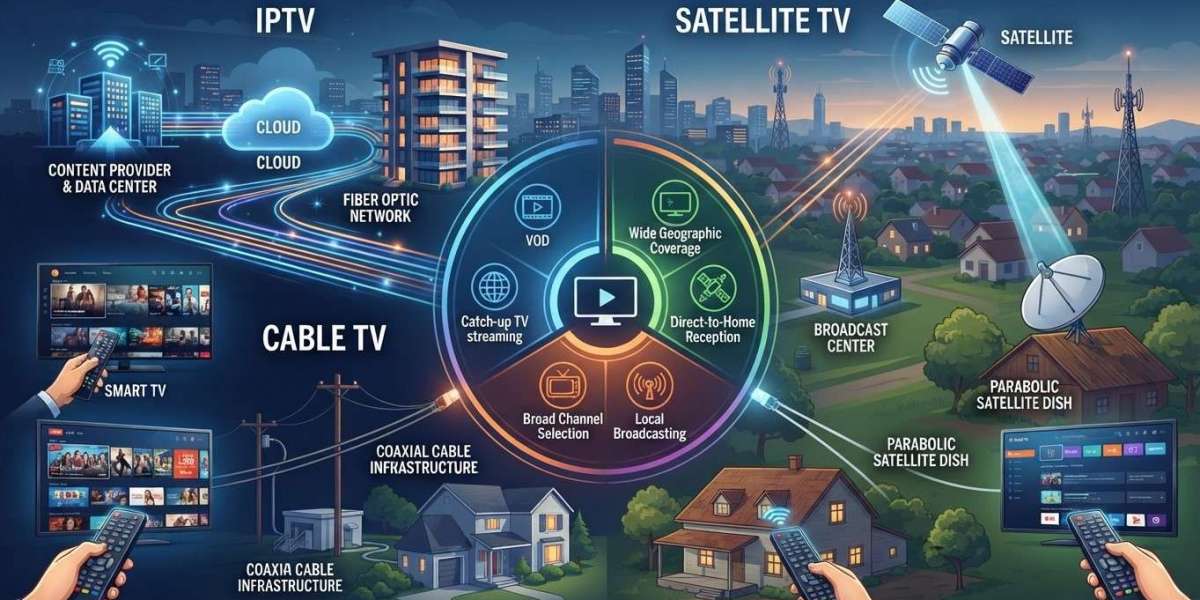
If you've been hearing the term "IPTV" everywhere but aren't quite sure what it means or why so many people are switching to it, you're in the right place. IPTV has quietly become one of the most popular ways for Indian, Pakistani, and Bangladeshi households in the USA to watch home television, and understanding how it actually works makes it much easier to see why. This guide breaks down what IPTV is, how it compares to traditional cable and satellite TV, and why services like Indian IPTV USA are winning over so many South Asian households across the country.
Table of Contents
- What Does IPTV Actually Mean?
- How IPTV Works
- How Cable TV Works
- How Satellite TV Works
- IPTV vs. Cable vs. Satellite: Side-by-Side Comparison
- Key Advantages of IPTV Over Traditional TV
- Are There Any Downsides to IPTV?
- Why IPTV Is Especially Popular Among Indian Households in the USA
- Which Option Is Right for You?
- Frequently Asked Questions
What Does IPTV Actually Mean?
IPTV stands for Internet Protocol Television. Instead of receiving channels through a satellite dish mounted on your roof or a coaxial cable running into your wall, IPTV delivers television content directly over your existing internet connection. The video is broken into data packets, sent over the internet, and reassembled on your screen in real time, the same basic principle used by services like Netflix or YouTube, but built around live, scheduled channel lineups rather than just on-demand libraries.
In simple terms: if you have decent home internet, you have everything you need to run IPTV. There's no separate infrastructure required.
How IPTV Works
Watching IPTV typically involves three simple pieces:
- A subscription service that licenses and streams the channels
- A device to play it on, such as a Smart TV, Firestick, Android box, or a dedicated set-top box like an Indian IPTV Box
- An app, such as IPTV Smarters or TiviMate, where you log in with your credentials and access the full channel guide
Once set up, channels load almost instantly, and most providers include an electronic program guide (EPG) so you can browse what's currently airing, exactly like a traditional cable guide, along with features like live pause, rewind, and recording.
How Cable TV Works
Cable television delivers channels through a physical coaxial cable that runs from your local cable provider's network directly into your home. This requires a technician visit for installation, a cable box for each TV, and often a long-term contract. Channel availability depends entirely on what your specific cable provider offers in your region, which is a real limitation if you're looking for niche regional Indian content.
How Satellite TV Works
Satellite TV works by broadcasting signals from an orbiting satellite down to a dish installed on your property, which then feeds the signal into a receiver box connected to your TV. This method can offer a wide range of channels, but it comes with its own headaches: the dish needs a clear line of sight to the sky, heavy rain or snow can disrupt the signal, and installation is often more invasive than a simple internet-based setup.
IPTV vs. Cable vs. Satellite: Side-by-Side Comparison
| Feature | IPTV | Cable TV | Satellite TV |
|---|---|---|---|
| Installation | None — works over existing internet | Technician visit required | Dish installation required |
| Equipment | Smart TV, Firestick, Android box, or IPTV box | Cable box | Satellite dish + receiver |
| Contract | Usually no long-term contract | Often requires a contract | Often requires a contract |
| Weather sensitivity | Not affected by weather | Not affected by weather | Can be disrupted by storms |
| Regional/international channels | Extensive, including niche regional content | Limited by provider's local offerings | Moderate, depends on package |
| Multi-device access | Yes, on phones, tablets, TVs | Typically single TV per box | Typically single TV per receiver |
| Cost | Generally more affordable | Often expensive with add-on fees | Often expensive with add-on fees |
| Setup time | Minutes | Days (scheduling required) | Days (scheduling required) |
Key Advantages of IPTV Over Traditional TV
No dish, no cable line, no technician. Since IPTV runs over your existing internet, you can be watching within minutes of subscribing, without ever waiting for an installation appointment.
Massive channel selection. Because IPTV isn't limited by regional broadcast towers or satellite footprints, providers can offer hundreds of live channels spanning Hindi, Punjabi, Tamil, Telugu, Malayalam, Marathi, Bengali, and more, all in one subscription.
Watch on any device. IPTV isn't tied to one box in one room. You can log into your account on a Smart TV, Firestick, phone, tablet, or PC, often at no extra charge.
No long-term contracts. Most IPTV providers offer flexible monthly or annual plans with no auto-renewal traps, unlike many cable and satellite agreements.
Modern features built in. Live pause, rewind, recording, and a clean EPG guide come standard with most quality IPTV services, features that used to require premium cable packages.
Are There Any Downsides to IPTV?
IPTV does depend on a stable internet connection, so a very slow or unreliable connection can affect stream quality. It's also important to choose a licensed, reputable provider, since the IPTV market does include unauthorized services that stream content without proper rights. Sticking with an established, transparent provider avoids both of these issues entirely.
Why IPTV Is Especially Popular Among Indian Households in the USA
For the South Asian diaspora, staying connected to home entertainment has traditionally meant limited, expensive add-on packages from cable and satellite providers, if regional channels were even available at all. IPTV changes that completely by offering dedicated access to Hindi, Punjabi, Tamil, Telugu, Malayalam, Marathi, Bengali, Gujarati, Kannada, and other regional content, all through one straightforward subscription that works anywhere you have internet access.
This is exactly the gap that services like Indian IPTV USA are built to fill, bringing hundreds of live channels, Bollywood movies, live cricket, and devotional programming into homes across the US and Canada without the usual cable-company runaround.
Which Option Is Right for You?
If you want a large, flexible channel selection focused on Indian content, minimal setup hassle, and the freedom to watch on multiple devices without a long-term contract, IPTV is generally the better choice. Cable and satellite may still make sense for households deeply invested in existing bundles or local sports blackout considerations, but for South Asian families looking specifically for home-country content, IPTV is usually the simpler and more complete solution.
Frequently Asked Questions
Is IPTV better than cable TV? For most South Asian households looking for regional Indian content, yes. IPTV typically offers more channels, more flexibility, and lower costs without a long-term contract.
Do I need special equipment for IPTV? You just need a device like a Smart TV, Firestick, Android box, or a dedicated IPTV box, along with a stable internet connection.
Does IPTV work the same as satellite TV? No. Satellite TV needs a physical dish and receiver, while IPTV streams entirely over your internet connection with no outdoor equipment required.
Can I watch IPTV on multiple devices at once? Yes, most IPTV subscriptions support multiple devices, including Smart TVs, phones, tablets, and PCs, often under a single login.
Is IPTV cheaper than cable or satellite? Generally, yes. IPTV subscriptions tend to be more affordable than cable or satellite packages, especially when you factor in the extra regional channel packs those services often charge for separately.
Ready to Make the Switch?
Experience the difference for yourself with Indian IPTV USA — hundreds of live Hindi, Punjabi, Tamil, and Telugu channels in HD and 4K, streamed directly over your internet with no dish and no contract. Pair your subscription with a reliable Indian IPTV Box for the best possible viewing experience on your TV.