Magnetite Nanoparticles Market Future Growth and Industry Developments
Magnetite Nanoparticles Market to Reach USD 258.92 Million by 2034, Driven by Nanotechnology Innovation
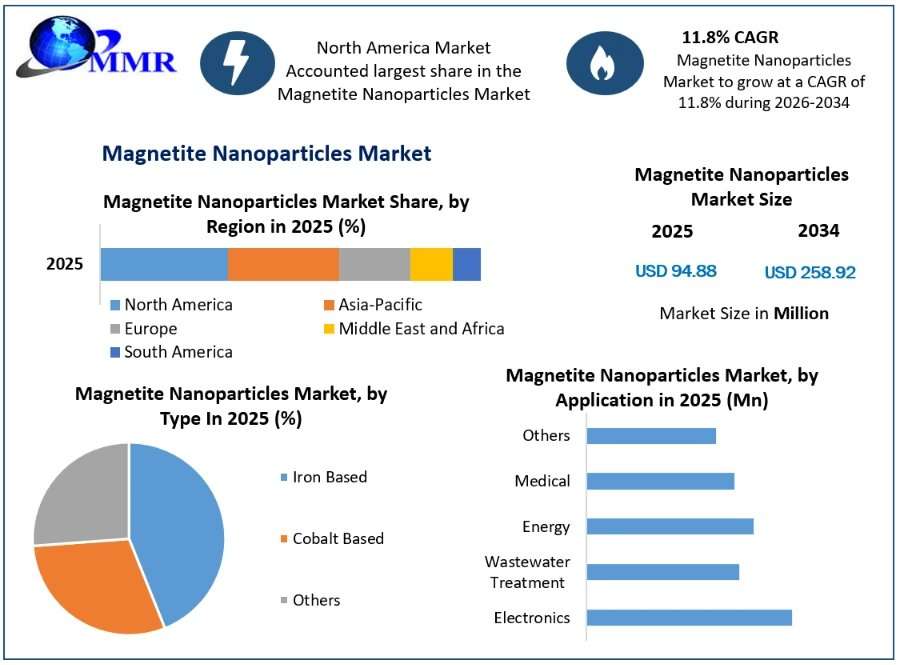
The Magnetite Nanoparticles Market is experiencing increasing interest as advancements in nanotechnology, biomedical research, environmental remediation, and magnetic materials create new opportunities for industrial and scientific applications. According to Maximize Market Research, the market is projected to grow at a compound annual growth rate (CAGR) of 11.8% during the forecast period, reaching approximately USD 258.92 million by 2034. Rising demand for advanced diagnostic technologies, targeted drug delivery, water treatment solutions, and high-performance magnetic materials is supporting the market’s expansion.
Market Estimation, Growth Drivers, and Opportunities
Magnetite nanoparticles, composed primarily of iron oxide (Fe₃O₄), possess distinctive magnetic properties, high surface-area-to-volume ratios, and tunable surface chemistry. These characteristics make them suitable for applications across healthcare, electronics, chemical processing, energy storage research, and environmental management. Their adaptability allows manufacturers and researchers to develop specialized materials for applications requiring magnetic responsiveness, efficient separation, and surface functionalization.
The market’s projected 11.8% CAGR reflects the growing commercial and research interest in nanomaterials. In healthcare, magnetite nanoparticles are being investigated for magnetic resonance imaging (MRI) contrast enhancement, magnetic hyperthermia, targeted drug delivery, and biosensing. Although several applications remain subject to clinical validation and regulatory requirements, continued research is creating opportunities for specialized nanoparticle manufacturers.
Environmental applications are another important growth driver. Magnetite nanoparticles can support the removal of selected contaminants from wastewater and facilitate magnetic separation and recovery processes. Their potential use in pollutant adsorption and treatment technologies is attracting interest as industries pursue more efficient environmental management solutions.
Opportunities are also emerging in magnetic sensors, catalysts, electromagnetic materials, and energy-related research. However, commercial success will depend on consistent particle size, controlled magnetic properties, scalable production, safety assessments, and competitive manufacturing costs.
Get Your Free Sample Report Link : https://www.maximizemarketrese....arch.com/request-sam
United States Market: Latest Trends and Investment Outlook
In 2025, the United States continued to offer opportunities for advanced materials research through investment in biotechnology, semiconductor technologies, nanomanufacturing, and environmental innovation. Magnetite nanoparticles are relevant to these fields because their magnetic characteristics can support experimental diagnostic platforms, separation technologies, sensor development, and specialized material systems. Research funding, university-industry partnerships, and federal initiatives supporting advanced manufacturing and biomedical innovation provide a favorable environment for research and commercialization. Investment opportunities include surface-functionalized nanoparticles, reproducible manufacturing processes, and application-specific formulations. Nevertheless, broader nanotechnology investment does not necessarily translate directly into magnetite nanoparticle revenue, and individual project funding or market-share gains should be assessed separately.
Market Segmentation: Leading Segment Considerations
The Magnetite Nanoparticles Market can be analyzed through application, particle characteristics, end-use industries, and geographical demand. Healthcare and biomedical research represent important application areas because magnetite nanoparticles offer magnetic responsiveness and opportunities for functionalization. Environmental remediation and water treatment also provide attractive applications because magnetic separation can simplify the recovery of certain materials after treatment.
Industrial and research applications benefit from the versatility of iron oxide nanomaterials, particularly where magnetic properties, chemical stability, and controlled surface characteristics are important. However, the precise largest segment and its market share should be confirmed against the detailed segmentation in the Maximize Market Research report. No unsupported numerical share is assigned here.
 お気に入り
お気に入り
-

-

-

-

-

-

コメント
シェア
Magnetite Nanoparticles Market Future Growth and Industry Developments
Magnetite Nanoparticles Market to Reach USD 258.92 Million by 2034, Driven by Nanotechnology Innovation
The Magnetite Nanoparticles Market is experiencing increasing interest as advancements in nanotechnology, biomedical research, environmental remediation, and magnetic materials create new opportunities for industrial and scientific applications. According to Maximize Market Research, the market is projected to grow at a compound annual growth rate (CAGR) of 11.8% during the forecast period, reaching approximately USD 258.92 million by 2034. Rising demand for advanced diagnostic technologies, targeted drug delivery, water treatment solutions, and high-performance magnetic materials is supporting the market’s expansion.
Market Estimation, Growth Drivers, and Opportunities
Magnetite nanoparticles, composed primarily of iron oxide (Fe₃O₄), possess distinctive magnetic properties, high surface-area-to-volume ratios, and tunable surface chemistry. These characteristics make them suitable for applications across healthcare, electronics, chemical processing, energy storage research, and environmental management. Their adaptability allows manufacturers and researchers to develop specialized materials for applications requiring magnetic responsiveness, efficient separation, and surface functionalization.
The market’s projected 11.8% CAGR reflects the growing commercial and research interest in nanomaterials. In healthcare, magnetite nanoparticles are being investigated for magnetic resonance imaging (MRI) contrast enhancement, magnetic hyperthermia, targeted drug delivery, and biosensing. Although several applications remain subject to clinical validation and regulatory requirements, continued research is creating opportunities for specialized nanoparticle manufacturers.
Environmental applications are another important growth driver. Magnetite nanoparticles can support the removal of selected contaminants from wastewater and facilitate magnetic separation and recovery processes. Their potential use in pollutant adsorption and treatment technologies is attracting interest as industries pursue more efficient environmental management solutions.
Opportunities are also emerging in magnetic sensors, catalysts, electromagnetic materials, and energy-related research. However, commercial success will depend on consistent particle size, controlled magnetic properties, scalable production, safety assessments, and competitive manufacturing costs.
Get Your Free Sample Report Link : https://www.maximizemarketrese....arch.com/request-sam
United States Market: Latest Trends and Investment Outlook
In 2025, the United States continued to offer opportunities for advanced materials research through investment in biotechnology, semiconductor technologies, nanomanufacturing, and environmental innovation. Magnetite nanoparticles are relevant to these fields because their magnetic characteristics can support experimental diagnostic platforms, separation technologies, sensor development, and specialized material systems. Research funding, university-industry partnerships, and federal initiatives supporting advanced manufacturing and biomedical innovation provide a favorable environment for research and commercialization. Investment opportunities include surface-functionalized nanoparticles, reproducible manufacturing processes, and application-specific formulations. Nevertheless, broader nanotechnology investment does not necessarily translate directly into magnetite nanoparticle revenue, and individual project funding or market-share gains should be assessed separately.
Market Segmentation: Leading Segment Considerations
The Magnetite Nanoparticles Market can be analyzed through application, particle characteristics, end-use industries, and geographical demand. Healthcare and biomedical research represent important application areas because magnetite nanoparticles offer magnetic responsiveness and opportunities for functionalization. Environmental remediation and water treatment also provide attractive applications because magnetic separation can simplify the recovery of certain materials after treatment.
Industrial and research applications benefit from the versatility of iron oxide nanomaterials, particularly where magnetic properties, chemical stability, and controlled surface characteristics are important. However, the precise largest segment and its market share should be confirmed against the detailed segmentation in the Maximize Market Research report. No unsupported numerical share is assigned here.